
How much do MLB hitters sit on the fastball?
Inspired by a question from Tom Tango, a look at what Baseball Savant's new swing timing data reveals.


MLB’s senior data architect, Tom Tango, posed a simple question on X after Baseball Savant rolled out its new bat-tracking swing timing metrics:
“How much do hitters sit on fastballs, and how much are they early on the other pitches?”
It caught my attention because baseball has always assumed it knows the answer. We hear hitters are “sitting dead red.” We hear pitchers trying to disrupt timing by changing speeds. But despite decades of Statcast research into velocity, tunneling and pitch design, we’ve never actually been able to measure whether hitters are timing their swings for the fastball.
The new swing timing data changes that. For the first time, Statcast classifies every swing as early, on time or late based on whether the barrel reaches the ideal contact point within seven milliseconds of perfect timing. That gives us a direct way to test one of baseball's oldest assumptions.
So I decided to see what the data says. Before looking at individual pitchers like Paul Skenes, I wanted to answer Tango’s question as simply as possible: How much do major league hitters actually sit on the fastball?
Across more than 200,000 tracked swings in 2026, hitters were late on fastballs 23 percent of the time and early just three percent. Against secondary pitches, the pattern flipped almost perfectly: hitters were early 43 percent of the time and late only five percent.
Breaking the data down by pitch type shows a clear progression. Breaking the data down by pitch type shows the same pattern. Four-seam fastballs and sinkers produce the highest rates of late swings, while sliders, changeups, sweepers and curveballs produce progressively higher rates of early swings.
The league-wide numbers are exactly what we’d expect if hitters generally gear their swings for fastball velocity. The interesting question is whether some pitchers are better than others at exploiting that tendency. However, the league averages establish a baseline but they don’t tell us whether certain pitchers are especially good at disrupting timing.
To find out, I compared every pitcher’s individual offerings to the league average for that same pitch type. In other words, Paul Skenes' slider isn't compared to his fastball, it's compared to every other slider in baseball. The same is true for every four-seam fastball, changeup, curveball and splitter.
That allows us to ask a more specific question: Which pitches make hitters significantly earlier or later than they are against the average version of that pitch?
Skenes provides an interesting first test case. With a fastball that averages nearly 99 mph and one of baseball’s best strikeout rates, he would seem like an obvious candidate to produce unusual swing timing. But when we compare his pitches to league averages, the results are more nuanced. Some of his pitches behave almost exactly like the league. Others stand out dramatically.
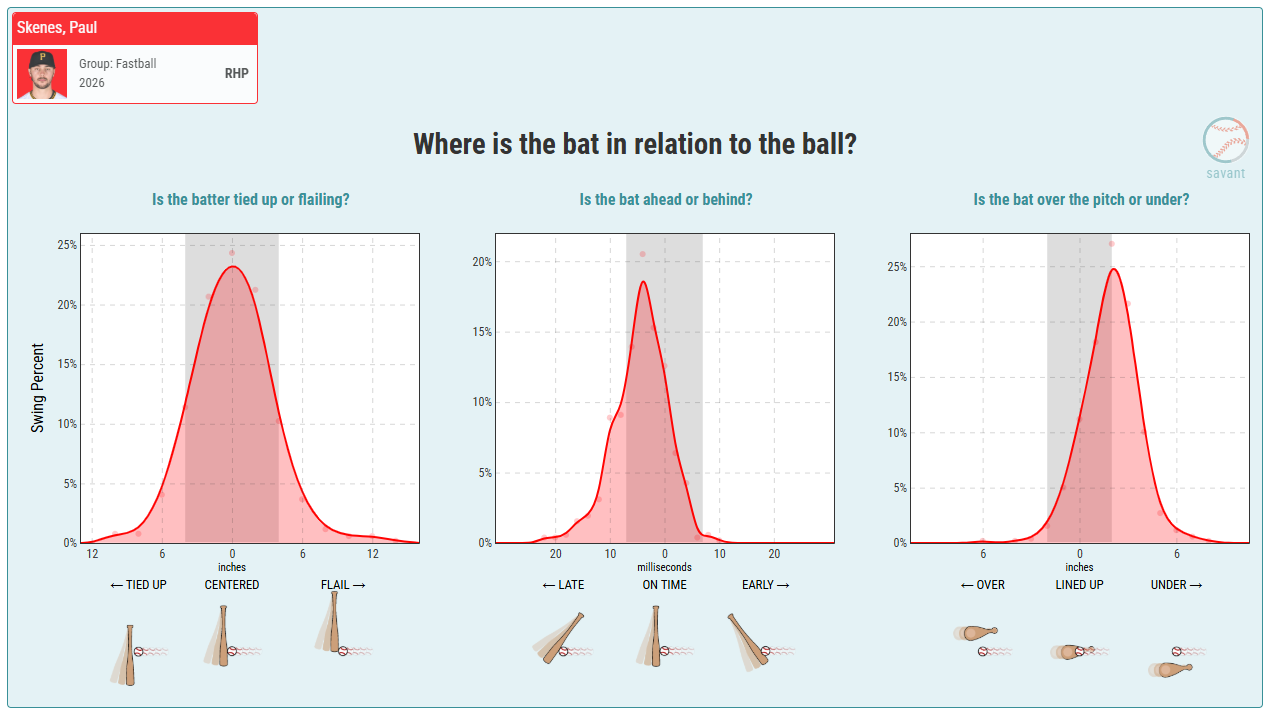
Skenes doesn't consistently produce unusual swing timing across his entire arsenal. His four-seam fastball, sinker and sweeper all generate early swing rates that are close to league average for those pitch types.
Two pitches stand apart. Hitters are 16 percentage points more likely to be early against Skenes' slider than against the average slider. Against his splitter, they're 32 percentage points less likely to be early than against the average splitter. Those two pitches, not his fastball, are what make Skenes' swing timing profile unusual.
Tango’s question turns out to have a straightforward answer. Across Major League Baseball, the data strongly suggest hitters are generally geared for fastball velocity. When they’re wrong, they’re usually late against velocity and early against everything else.
The broader takeaway is that the league-wide pattern isn't uniform. Comparing pitchers to the average version of each pitch shows that some offerings consistently disrupt hitters' timing more than others. In Skenes' case, the biggest outliers aren't his blazing fastball, they're his slider and splitter.